Blake2b Case Study
The case study in this section concerns a correct-by-construction design and implementation of the Blake2b cryptographic hash function in ReWire. This case
There are several relevant publications:
- Temporal Staging for Correct-by-Construction Cryptographic Hardware. This paper was written by Yakir Forman and myself and published in the Rapid Systems Prototyping Symposium in 2024. This paper describes a reference semantics for Blake2b and a ReWire hardware design that comes directly from it. It also describes a formal verification in Coq of the correctness of the ReWire design. There are slides for this paper and (2) at the respective links.
- Formalized High Level Synthesis with Applications to Cryptographic Hardware. This paper presents the mechanized semantics for ReWire on which the formal verification in (1) is based.
- The RFP for Blake2 written by Markku-Juhani O. Saarinen and Jean-Philippe Aumasson. This is available here: https://www.rfc-editor.org/info/rfc7693. The reference semantics for Blake2b is a transliteration of this into Haskell/ReWire.
Reference Semantics
The reference semantics is defined in terms of a state monad, Storage, that manages accesses to a register file, RegFile. There are 40 registers, each of which is a 64-bit word (i.e., W 64 in ReWire). The RegFile itself is represented as a 40 element vector of W 64 and individual registers are indices into this vector, represented by the Finite 40 type.
type Storage s = StateT s Identity
type RegFile   = Vec 40 (W 64)
type Reg       = Finite 40
Just as an example, consider the compression function F of Blake2b; here is its pseudocode:
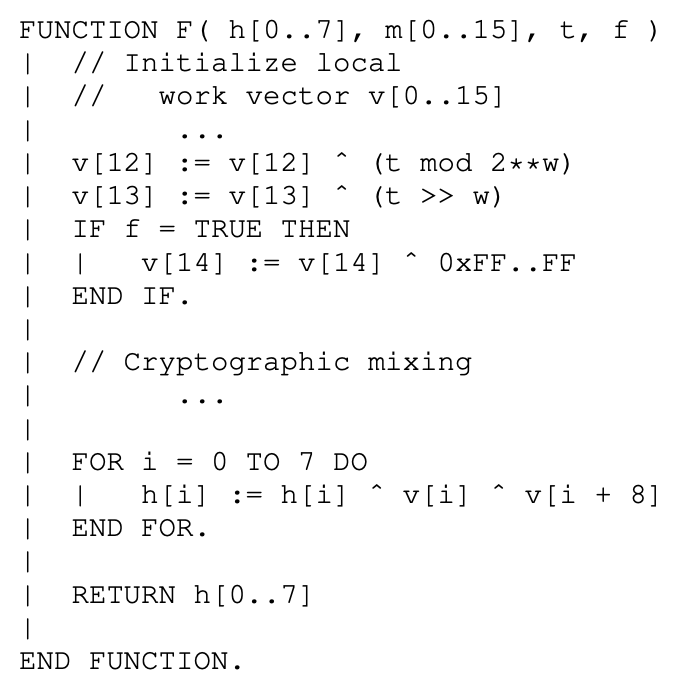
_F :: W 128 -> Bit -> Storage RegFile ()
_F t f = do
           init_local_work_vector
           v12 <== do { w <- readReg v12 ; return $ w ^ lowword t }
           v13 <== do { w <- readReg v13 ; return $ w ^ highword t }
           if f then
                  v14 <== do { w <- readReg v14 ; return $ w ^ lit 0xffffffffffffffff }
                else
                  return ()
           cryptographic_mixing
           xor_two_halves
import Blake2b.Reference hiding (readH , _F , _BLAKE2b)